
If someone were to ask me for a favourite quote, the words of the second-century Church Father, Irenaeus, Bishop of Lyon, would probably come to mind first. It is a well-known phrase in Latin: “Gloria Dei est vivens homo!”. In English, this is translated as, “The glory of God is a human fully alive.” I simply translate it as, “God is glorified by someone who truly lives, and not merely exists.”
In Irenaeus’ time – while Christians were being persecuted for their faith – there was only one person who could claim to truly live, and that was the one willing to sacrifice their life as a disciple of Jesus. Like Martin Luther, who, at his trial in 1521 (when asked to retract his statements), replied: “Here I stand. I can do no other.” If your devotion to God is more important to you than anything else, only then can you claim to truly live! Gloria Dei!
This makes me ask myself: am I truly living, or am I just a “living corpse”? I may be very busy, feel successful, or have achieved many things in life; but if the driving force in my life is not to give glory to God alone, then I am missing the whole point. Soli Deo Gloria.
David, the psalmist, writes in Psalm 119: “Turn my eyes away from worthless things; preserve my life according to your word” (v37). It is even more beautifully rendered in the 2020 translation: “Turn my eyes away from gazing at worthless things; keep me alive on your paths.”
PRAYER: Heavenly Father, help me to turn my eyes away from the vanity of this world and focus on Your ways. Refresh my heart and soul so that I may live fully in Your presence. May my life be a testimony to Your glory.
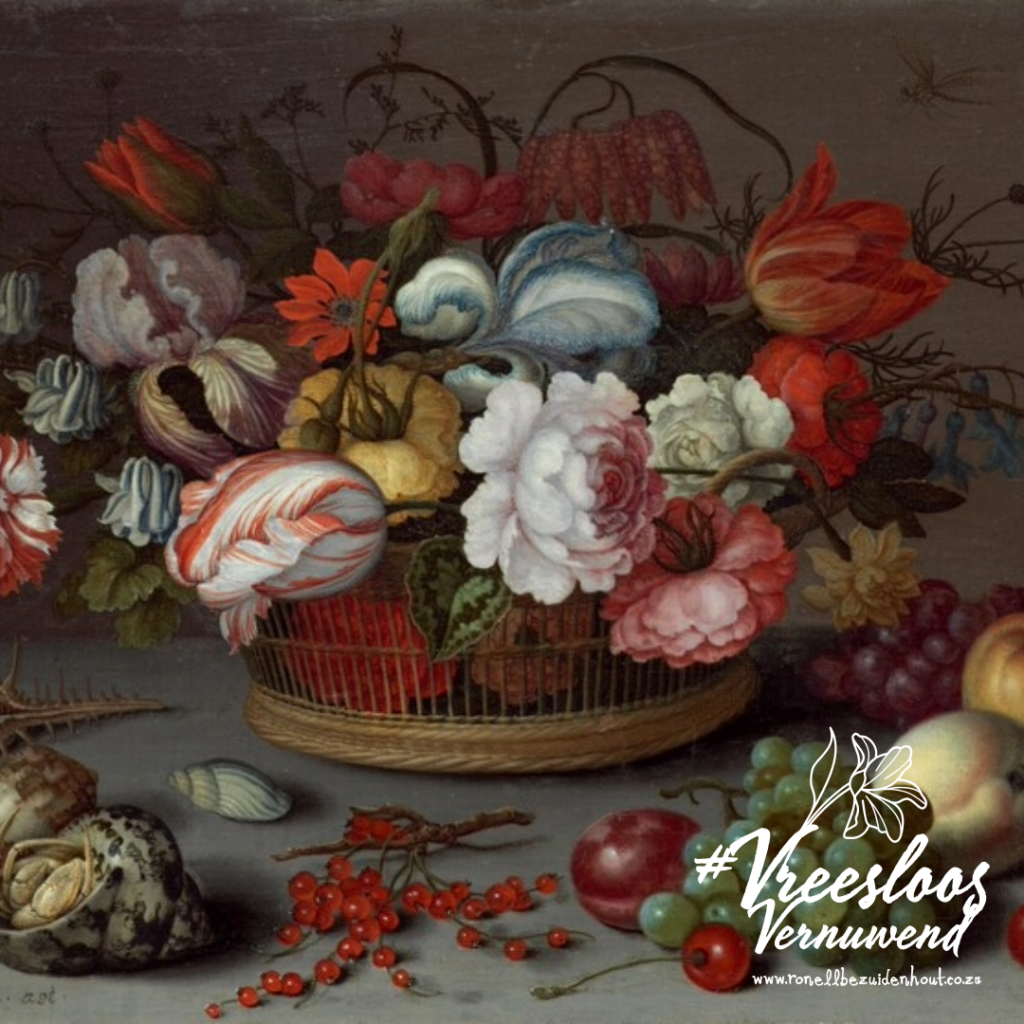
ART: Balthasar van der Ast, Basket of Flowers, 1622.
MUSIC:
“Be still, my soul: when change and tears are past, all safe and blessed we shall meet at last.”
The music for “Be Still My Soul” is a hymn-like section from the symphonic poem Finlandia, composed in 1899 by the Finnish composer Jean Sibelius.
Katharina von Schlegel (1697 – 1768) originally wrote the German lyrics “Stille meine Wille, dein Jesus hilft siegen” in 1752, and the hymn was later translated into English by Jane Laurie Borthwick (1813 – 1897) in 1855.
The recording is by the Kantorei Choral Society.